Mysql Connector .net Vb.net Sample Code Read Value to String
MySQL Visual Bones
last modified July vi, 2020
This is a Visual Basic tutorial for the MySQL database. It covers the basics of MySQL programming with Visual Basic. In this tutorial, we use the Connector/Net driver. This driver is based on the ADO.NET specification. The examples were created and tested on Ubuntu Linux. There is a similar MySQL C# tutorial, MySQL Perl tutorial and SQLite Visual Basic tutorial on ZetCode.
If you demand to refresh your knowledge of the Visual Basic language, there is a full Visual Basic tutorial on ZetCode.
About MySQL database
MySQL is a leading open up source database management system. Information technology is a multi user, multithreaded database management system. MySQL is particularly popular on the spider web. It is one of the parts of the very popular LAMP platform consisting of Linux, Apache, MySQL, and PHP. Currently MySQL is endemic by Oracle. MySQL database is available on nigh important Os platforms. Information technology runs on BSD Unix, Linux, Windows, or Mac OS. Wikipedia and YouTube use MySQL. These sites manage millions of queries each day. MySQL comes in two versions: MySQL server system and MySQL embedded organisation.
Earlier we start
Nosotros need to install several packages to execute the examples in this tutorial: libmysql6.i-cil, mysql-server, mysql-client. We need to install Visual Basic compiler from the Mono project. Either from a packet or from sources.
The libmysql6.i-cil is the MySQL database connector for CLI. Information technology is written in C# and is available for all CLI languages. C#, Visual Basic, Boo and others.
$ ls /usr/lib/cli/MySql.Information-vi.1/MySql.Information.dll /usr/lib/cli/MySql.Data-half dozen.1/MySql.Data.dll
From the technical point of view, we demand a DLL. On my system (Ubuntu Lucid Lynx), it was located under the above path. Nosotros need to know the path to the DLL library. To compile our examples.
If you lot don't already have MySQL installed, nosotros must install it.
$ sudo apt-get install mysql-server
This command installs the MySQL server and various other packages. While installing the bundle, nosotros are prompted to enter a password for the MySQL root account.
Next, we are going to create a new database user and a new database. We use the mysql client.
$ service mysql condition mysql starting time/running, process 1238
Nosotros check if the MySQL server is running. If not, we need to start the server. On Ubuntu Linux, this can be done with the service mysql start command.
$ mysql -u root -p Enter password: Welcome to the MySQL monitor. Commands cease with ; or \thou. Your MySQL connection id is thirty Server version: 5.0.67-0ubuntu6 (Ubuntu) Type 'help;' or '\h' for help. Type '\c' to articulate the buffer. mysql> Prove DATABASES; +--------------------+ | Database | +--------------------+ | information_schema | | mysql | +--------------------+ two rows in prepare (0.00 sec)
We use the mysql monitor customer awarding to connect to the server. We connect to the database using the root account. Nosotros show all bachelor databases with the Testify DATABASES statement.
mysql> CREATE DATABASE testdb; Query OK, i row affected (0.02 sec)
We create a new testdb database. We will utilize this database throughout the tutorial.
mysql> CREATE USER 'testuser'@'localhost' IDENTIFIED By 'test623'; Query OK, 0 rows affected (0.00 sec) mysql> USE testdb; Database changed mysql> GRANT ALL ON testdb.* TO 'testuser'@'localhost'; Query OK, 0 rows affected (0.00 sec) mysql> quit; Cheerio
We create a new database user. We grant all privileges to this user for all tables of the testdb database.
Definitions
ADO.Internet is an important part of the .Net framework. It is a specification that unifies access to relational databases, XML files and other awarding data. A MySQL Connector/Net is an implementation of the ADO.Internet specification for the MySQL database. Information technology is a driver written in C# language and is bachelor for all .NET languages.
The Connection, Command, DataReader, DataSet, and DataProvider are the core elements of the .Internet data provider model. The Connectedness creates a connection to a specific data source. The Command object executes an SQL argument against a data source. The DataReader reads streams of data from a data source. The DataSet object is used for offline piece of work with a mass of data. It is a disconnected data representation that can agree data from a diverseness of different sources. Both DataReader and DataSet are used to work with information; they are used under dissimilar circumstances. If nosotros only demand to read the results of a query, the DataReader is the better choice. If we need more than all-encompassing processing of data, or we want to demark a Winforms control to a database table, the DataSet is preferred.
MySQL version
If the following program runs OK, then we take everything installed OK. We check the version of the MySQL server.
Option Strict On Imports MySql.Data.MySqlClient Module Case Sub Primary() Dim cs Every bit String = "Database=testdb;Data Source=localhost;" _ & "User Id=testuser;Countersign=test623" Dim conn As New MySqlConnection(cs) Try conn.Open() Console.WriteLine("MySQL version : {0}", conn.ServerVersion) Catch ex As MySqlException Console.WriteLine("Error: " & ex.ToString()) Finally conn.Close() End Try Finish Sub End Module We connect to the database and get some info about the MySQL server.
Imports MySql.Data.MySqlClient
Nosotros import the elements of the MySQL data provider.
Dim cs As Cord = "Database=testdb;Data Source=localhost;" _ & "User Id=testuser;Password=test623"
This is the connection cord. It is used by the data provider to constitute a connectedness to the database. We specify the database proper name, host, user name and countersign.
Dim conn As New MySqlConnection(cs)
A MySQLConnection object is created. This object is used to open up a connection to a database.
conn.Open()
This line opens the connection.
Panel.WriteLine("MySQL version : {0}", conn.ServerVersion) Here we impress the version of MySQL using the ServerVersion belongings of the connection object.
Catch ex Equally MySqlException Console.WriteLine("Error: " & ex.ToString()) In case of an exception, we print the mistake message to the console.
$ vbnc -r:/usr/lib/cli/MySql.Information-half dozen.1/MySql.Data.dll connect.vb
We compile our example. A path to the MySQL connector DLL is provided.
$ ./connect.exe MySQL version : 5.1.41-3ubuntu12.half-dozen
This is the output of the plan on my organisation.
A more complex plan follows.
Option Strict On Imports MySql.Information.MySqlClient Module Example Sub Master() Dim cs As String = "Database=testdb;Information Source=localhost;" _ & "User Id=testuser;Countersign=test623" Dim stm Equally String = "SELECT VERSION()" Dim version Equally String Dim conn As MySqlConnection Attempt conn = New MySqlConnection(cs) conn.Open() Dim cmd Every bit MySqlCommand = New MySqlCommand(stm, conn) version = Convert.ToString(cmd.ExecuteScalar()) Console.WriteLine("MySQL version: {0}", version) Catch ex As MySqlException Panel.WriteLine("Error: " & ex.ToString()) Finally conn.Close() End Endeavor Cease Sub Finish Module We bank check for the version of the MySQL database. This time using an SQL query.
Dim stm As String = "SELECT VERSION()"
This is the SQL SELECT statement. It returns the version of the database. The VERSION() is a congenital-in MySQL function.
Dim cmd Every bit MySqlCommand = New MySqlCommand(stm, conn)
The MySqlCommand is an object, which is used to execute a query on the database. The parameters are the SQL statement and the connection object.
version = Catechumen.ToString(cmd.ExecuteScalar())
There are queries which render only a scalar value. In our instance, nosotros desire a unproblematic string specifying the version of the database. The ExecuteScalar() is used in such situations. Nosotros avert the overhead of using more than complex objects.
$ ./connect2.exe MySQL version : v.1.41-3ubuntu12.6
Same result as in the previous example.
Creating and populating tables
Adjacent we are going to create database tables and fill them with data. These tables will be used throughout this tutorial.
Drib Tabular array IF EXISTS Books, Authors; CREATE TABLE IF Non EXISTS Authors(Id INT PRIMARY KEY AUTO_INCREMENT, Name VARCHAR(25)) ENGINE=INNODB; INSERT INTO Authors(Id, Name) VALUES(1, 'Jack London'); INSERT INTO Authors(Id, Name) VALUES(2, 'Honore de Balzac'); INSERT INTO Authors(Id, Name) VALUES(three, 'King of beasts Feuchtwanger'); INSERT INTO Authors(Id, Name) VALUES(4, 'Emile Zola'); INSERT INTO Authors(Id, Name) VALUES(5, 'Truman Capote'); CREATE Table IF NOT EXISTS Books(Id INT PRIMARY Key AUTO_INCREMENT, AuthorId INT, Championship VARCHAR(100), Foreign KEY(AuthorId) REFERENCES Authors(Id) ON DELETE CASCADE) ENGINE=INNODB; INSERT INTO Books(Id, AuthorId, Title) VALUES(1, 1, 'Telephone call of the Wild'); INSERT INTO Books(Id, AuthorId, Title) VALUES(2, one, 'Martin Eden'); INSERT INTO Books(Id, AuthorId, Championship) VALUES(3, 2, 'Old Goriot'); INSERT INTO Books(Id, AuthorId, Title) VALUES(4, 2, 'Cousin Bette'); INSERT INTO Books(Id, AuthorId, Championship) VALUES(5, three, 'Jew Suess'); INSERT INTO Books(Id, AuthorId, Title) VALUES(6, iv, 'Nana'); INSERT INTO Books(Id, AuthorId, Title) VALUES(7, 4, 'The Belly of Paris'); INSERT INTO Books(Id, AuthorId, Title) VALUES(8, 5, 'In Cold blood'); INSERT INTO Books(Id, AuthorId, Title) VALUES(9, 5, 'Breakfast at Tiffany');
We have a books.sql file. It creates two database tables: Authors, and Books. The tables are of InnoDB type. InnoDB databases support foreign key constraints and transactions. We place a strange key constraint on the AuthorId column of the Books table. Nosotros fill the tables with initial information.
mysql> source books.sql Query OK, 0 rows affected (0.07 sec) Query OK, 0 rows affected (0.12 sec) Query OK, 1 row affected (0.04 sec) ...
We employ the source command to execute the books.sql script.
In the post-obit example, we are going to insert a new writer into the Authors table.
Option Strict On Imports MySql.Data.MySqlClient Module Example Sub Main() Dim connString Equally Cord = "Database=testdb;Information Source=localhost;" _ & "User Id=testuser;Password=test623" Dim conn As New MySqlConnection(connString) Dim cmd As New MySqlCommand() Endeavour conn.Open() cmd.Connectedness = conn cmd.CommandText = "INSERT INTO Authors(Name) VALUES(@Name)" cmd.Prepare() cmd.Parameters.AddWithValue("@Name", "Trygve Gulbranssen") cmd.ExecuteNonQuery() conn.Close() Catch ex As MySqlException Console.WriteLine("Mistake: " & ex.ToString()) Finish Try Finish Sub End Module We add a new author to the Authors tabular array. We apply a parameterized command.
cmd.CommandText = "INSERT INTO Authors(Proper name) VALUES(@Name)" cmd.Prepare()
Here we create a prepared argument. When we write prepared statements, we utilise placeholders instead of directly writing the values into the statements. Prepared statements are faster and guard against SQL injection attacks. The @Name is a placeholder, which is going to be filled later.
cmd.Parameters.AddWithValue("@Name", "Trygve Gulbranssen") A value is bound to the placeholder.
cmd.ExecuteNonQuery()
The prepared statement is executed. We apply the ExecuteNonQuery() method of the MySQLCommand object when we don't expect whatsoever data to be returned. This is when nosotros create databases or execute INSERT, UPDATE, DELETE statements.
$ ./prepared.exe mysql> select * from Authors; +----+--------------------+ | Id | Name | +----+--------------------+ | 1 | Jack London | | 2 | Honore de Balzac | | 3 | Lion Feuchtwanger | | iv | Emile Zola | | 5 | Truman Capote | | 6 | Trygve Gulbranssen | +----+--------------------+ 6 rows in prepare (0.00 sec)
We take a new author inserted into the table.
Retrieving data with MySqlDataReader
The MySqlDataReader is an object used to remember information from the database. It provides fast, forrard-only, read-only access to query results. Information technology is the most efficient way to call back information from tables.
Option Strict On Imports MySql.Data.MySqlClient Module Example Sub Main() Dim cs As String = "Database=testdb;Data Source=localhost;" _ & "User Id=testuser;Password=test623" Dim conn Every bit New MySqlConnection(cs) Try conn.Open() Dim stm Equally Cord = "SELECT * FROM Authors" Dim cmd As MySqlCommand = New MySqlCommand(stm, conn) Dim reader As MySqlDataReader = cmd.ExecuteReader() While reader.Read() Console.WriteLine(reader.GetInt32(0) & ": " _ & reader.GetString(1)) End While reader.Shut() Catch ex As MySqlException Console.WriteLine("Error: " & ex.ToString()) Finally conn.Close() End Endeavor Stop Sub Terminate Module Nosotros get all authors from the Authors tabular array and print them to the panel.
Dim reader Equally MySqlDataReader = cmd.ExecuteReader()
To create a MySQLDataReader, we must telephone call the ExecuteReader() method of the MySqlCommand object.
While reader.Read() Console.WriteLine(reader.GetInt32(0) & ": " _ & reader.GetString(1)) End While
The Read() method advances the information reader to the next record. It returns truthful if there are more rows; otherwise false. We can call back the value using the array index notation, or employ a specific method to access column values in their native information types. The latter is more than efficient.
reader.Shut()
Always telephone call the Shut() method when done reading.
$ ./read.exe ane: Jack London two: Honore de Balzac 3: Lion Feuchtwanger 4: Emile Zola v: Truman Capote half-dozen: Trygve Gulbranssen
This is the output of the example.
Column headers
Next we volition show, how to print column headers with the information from the database table.
Option Strict On Imports MySql.Data.MySqlClient Module Example Sub Main() Dim connString As Cord = "Database=testdb;Data Source=localhost;" _ & "User Id=testuser;Countersign=test623" Dim conn Every bit New MySqlConnection(connString) Try conn.Open up() Dim stm Every bit String = "SELECT Name, Title From Authors, " _ & "Books WHERE Authors.Id=Books.AuthorId" Dim cmd As MySqlCommand = New MySqlCommand(stm, conn) Dim reader As MySqlDataReader = cmd.ExecuteReader() Console.WriteLine("{0} {i}", reader.GetName(0), _ reader.GetName(1).PadLeft(eighteen)) While reader.Read() Panel.WriteLine(reader.GetString(0).PadRight(xviii) _ & reader.GetString(1)) End While reader.Close() Take hold of ex As MySqlException Panel.WriteLine("Mistake: " & ex.ToString()) Finally conn.Close() Finish Effort End Sub Cease Module In this program, nosotros select authors from the Authors table and their books from the Books table.
Dim stm As String = "SELECT Name, Title From Authors, " _ & "Books WHERE Authors.Id=Books.AuthorId"
This is the SQL argument which joins authors with their books.
Dim reader As MySqlDataReader = cmd.ExecuteReader()
We create a MySqlDataReader object.
Console.WriteLine("{0} {1}", reader.GetName(0), _ reader.GetName(ane).PadLeft(18)) We become the names of the columns with the GetName() method of the reader. The PadLeft() method returns a new string of a specified length in which the showtime of the current string is padded with spaces. We employ this method to marshal strings properly.
While reader.Read() Console.WriteLine(reader.GetString(0).PadRight(18) _ & reader.GetString(i)) End While
We print the information that was returned by the SQL statement to the terminal.
$ ./columns.exe Proper noun Title Jack London Telephone call of the Wild Jack London Martin Eden Honore de Balzac Onetime Goriot Honore de Balzac Cousin Bette King of beasts Feuchtwanger Jew Suess Emile Zola Nana Emile Zola The Belly of Paris Truman Capote In Common cold claret Truman Capote Breakfast at Tiffany
Ouput of the program.
DataSet & MySqlDataAdapter
A DataSet is a copy of the data and the relations among the data from the database tables. Information technology is created in memory and used when all-encompassing processing on data is needed or when we demark data tables to a Winforms control. When the processing is done, the changes are written to the information source. A MySqlDataAdapter is an intermediary between the DataSet and the information source. Information technology populates a DataSet and resolves updates with the data source.
Pick Strict On Imports System.Data Imports MySql.Information.MySqlClient Module Example Sub Chief() Dim cs As String = "Database=testdb;Information Source=localhost;" _ & "User Id=testuser;Password=test623" Dim conn As New MySqlConnection(cs) Dim stm As String = "SELECT * FROM Authors" Endeavor conn.Open() Dim da As New MySqlDataAdapter(stm, conn) Dim ds As New DataSet da.Fill(ds, "Authors") Dim dt Every bit DataTable = ds.Tables("Authors") dt.WriteXml("authors.xml") For Each row Equally DataRow In dt.Rows For Each col Equally DataColumn In dt.Columns Panel.WriteLine(row(col)) Side by side Console.WriteLine("".PadLeft(twenty, "=")) Next Catch ex As MySqlException Console.WriteLine("Error: " & ex.ToString()) Finally conn.Close() End Effort End Sub Cease Module We impress the authors from the Authors table. This fourth dimension, we use the MySqlDataAdapter and DataSet objects.
Dim da As New MySqlDataAdapter(stm, conn)
A MySqlDataAdapter object is created. It takes an SQL statement and a connection as parameters.
Dim ds As New DataSet da.Fill up(ds, "Authors")
We create and fill the DataSet.
Dim dt As DataTable = ds.Tables("Authors") We get the table called Authors. We have given a DataSet only one tabular array, simply it tin can contain multiple tables.
dt.WriteXml("authors.xml") Nosotros write the data to an XML file.
For Each row As DataRow In dt.Rows For Each col Equally DataColumn In dt.Columns Console.WriteLine(row(col)) Next Console.WriteLine("".PadLeft(twenty, "=")) Adjacent We display the contents of the Authors table to the terminal. To traverse the data, nosotros apply the rows and columns of the DataTable object.
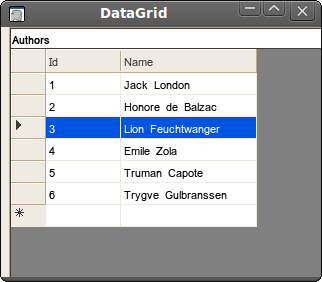
In the next case, we are going to demark a table to a Winforms DataGrid control.
Choice Strict On Imports System.Windows.Forms Imports System.Drawing Imports Arrangement.Data Imports MySql.Data.MySqlClient Public Class WinVBApp Inherits Form Private dg As DataGrid Private da As MySqlDataAdapter Private ds As DataSet Public Sub New() Me.Text = "DataGrid" Me.Size = New Size(350, 300) Me.InitUI() Me.InitData() Me.CenterToScreen() End Sub Private Sub InitUI() dg = New DataGrid dg.CaptionBackColor = System.Drawing.Colour.White dg.CaptionForeColor = Organization.Cartoon.Color.Black dg.CaptionText = "Authors" dg.Location = New Indicate(8, 0) dg.Size = New Size(350, 300) dg.TabIndex = 0 dg.Parent = Me End Sub Individual Sub InitData() Dim cs As String = "Database=testdb;Information Source=localhost;" _ & "User Id=testuser;Countersign=test623" Dim conn As New MySqlConnection(cs) Dim stm As String = "SELECT * FROM Authors" ds = New DataSet Try conn.Open up() da = New MySqlDataAdapter(stm, conn) da.Fill(ds, "Authors") dg.DataSource = ds.Tables("Authors") Grab ex Equally MySqlException Console.WriteLine("Error: " & ex.ToString()) Finally conn.Shut() End Try Finish Sub Public Shared Sub Main() Application.Run(New WinVBApp) Cease Sub Finish Class In this example, nosotros demark a Authors table to a Winforms DataGrid control.
Imports System.Windows.Forms Imports System.Drawing
These two namespaces are for the GUI.
Me.InitUI() Me.InitData()
Within the InitUI() method, nosotros build the user interface. In the InitData() method, we connect to the database, retrieve the data into the DataSet and demark information technology to the DataGrid control.
dg = New DataGrid
The DataGrid command is created.
Dim stm Equally String = "SELECT * FROM Authors"
We will display the data from the Authors tabular array in the DataGrid command.
dg.DataSource = ds.Tables("Authors") We bind the DataSource property of the DataGrid control to the called table.
vbnc -r:/usr/lib/mono/2.0/Organization.Windows.Forms.dll -r:/usr/lib/cli/MySql.Information-six.1/MySql.Data.dll grid.vb
To compile the instance, we must include two DLLs. The DLL for the Winforms and the DLL for the MySQL connector.
Transaction back up
A transaction is an diminutive unit of database operations against the data in i or more databases. The effects of all the SQL statements in a transaction can be either all committed to the database or all rolled dorsum.
The MySQL database has different types of storage engines. The most common are the MyISAM and the InnoDB engines. The MyISAM is the default ane. There is a merchandise-off between information security and database speed. The MyISAM tables are faster to process and they practice not back up transactions. On the other paw, the InnoDB tables are more safe against the data loss. They back up transactions. They are slower to process.
Option Strict On Imports MySql.Data.MySqlClient Module Example Sub Main() Dim cs As String = "Database=testdb;Information Source=localhost;" _ & "User Id=testuser;Password=test623" Dim conn As New MySqlConnection(cs) Dim cmd Every bit New MySqlCommand() Dim tr Every bit MySqlTransaction Try conn.Open() tr = conn.BeginTransaction() cmd.Connection = conn cmd.Transaction = tr cmd.CommandText = "UPDATE Authors Ready Name = 'Leo Tolstoy' WHERE Id = ane" cmd.ExecuteNonQuery() cmd.CommandText = "UPDATE Books Set Title = 'War and Peace' WHERE Id = 1" cmd.ExecuteNonQuery() cmd.CommandText = "UPDATE Books Set Titl = 'Anna Karenina' WHERE Id = two" cmd.ExecuteNonQuery() tr.Commit() conn.Shut() Grab ex As MySqlException tr.Rollback() Panel.WriteLine("Error: " & ex.ToString()) End Try End Sub Stop Module In this program, we want to alter the name of the author on the outset row of the Authors table. We must likewise alter the books associated with this author. A good case where a transaction is necessary. If we alter the author and exercise not change the author'due south books, the data is corrupted.
Dim tr As MySqlTransaction
The MySqlTransaction is an object for working with transactions.
tr = conn.BeginTransaction()
Nosotros begin a transaction.
cmd.CommandText = "UPDATE Books Fix Titl = 'Anna Karenina' WHERE Id = 2" cmd.ExecuteNonQuery()
The third SQL statement has an fault. In that location is no Titl cavalcade in the tabular array.
tr.Commit()
If there is no exception, the transaction is committed.
Catch ex As MySqlException tr.Rollback() Console.WriteLine("Error: " & ex.ToString()) In case of an exception, the transaction is rolled dorsum. No changes are committed to the database.
$ ./transaction.exe Error: MySql.Data.MySqlClient.MySqlException: Unknown column 'Titl' in 'field list' at MySql.Information.MySqlClient.MySqlStream.ReadPacket () [0x00000] at MySql.Data.MySqlClient.NativeDriver.ReadResult () [0x00000] mysql> SELECT Name, Championship From Authors, Books WHERE Authors.Id=Books.AuthorId; +-------------------+----------------------+ | Name | Title | +-------------------+----------------------+ | Jack London | Call of the Wild | | Jack London | Martin Eden | | Honore de Balzac | Quondam Goriot | | Honore de Balzac | Cousin Bette | | Lion Feuchtwanger | Jew Suess | | Emile Zola | Nana | | Emile Zola | The Abdomen of Paris | | Truman Capote | In Cold blood | | Truman Capote | Breakfast at Tiffany | +-------------------+----------------------+ 9 rows in fix (0.00 sec)
An exception was thrown. The transaction was rolled back and no changes took place.
Even so, without a transaction, the data is not rubber.
Pick Strict On Imports MySql.Information.MySqlClient Module Example Sub Master() Dim cs Equally Cord = "Database=testdb;Data Source=localhost;" _ & "User Id=testuser;Password=test623" Dim conn Every bit New MySqlConnection(cs) Dim cmd As New MySqlCommand() Endeavor conn.Open() cmd.Connection = conn cmd.CommandText = "UPDATE Authors SET Proper noun = 'Leo Tolstoy' WHERE Id = 1" cmd.ExecuteNonQuery() cmd.CommandText = "UPDATE Books Set Title = 'War and Peace' WHERE Id = 1" cmd.ExecuteNonQuery() cmd.CommandText = "UPDATE Books SET Titl = 'Anna Karenina' WHERE Id = two" cmd.ExecuteNonQuery() conn.Close() Catch ex As MySqlException Panel.WriteLine("Mistake: " & ex.ToString()) Finish Try End Sub Cease Module We have the aforementioned example. This time, without the transaction support.
$ ./update.exe Error: MySql.Data.MySqlClient.MySqlException: Unknown cavalcade 'Titl' in 'field list' at MySql.Data.MySqlClient.MySqlStream.ReadPacket () [0x00000] at MySql.Data.MySqlClient.NativeDriver.ReadResult () [0x00000] mysql> SELECT Proper noun, Title From Authors, Books WHERE Authors.Id=Books.AuthorId; +-------------------+----------------------+ | Name | Title | +-------------------+----------------------+ | Leo Tolstoy | State of war and Peace | | Leo Tolstoy | Martin Eden | | Honore de Balzac | Old Goriot | | Honore de Balzac | Cousin Bette | | Lion Feuchtwanger | Jew Suess | | Emile Zola | Nana | | Emile Zola | The Belly of Paris | | Truman Capote | In Common cold blood | | Truman Capote | Breakfast at Tiffany | +-------------------+----------------------+ 9 rows in set up (0.00 sec)
An exception is thrown again. Leo Tolstoy did not write Martin Eden. The data is corrupted.
This was the MySQL Visual Basic tutorial, with MySQL Connector. Y'all might be also interested in MySQL C API tutorial, PyMySQL tutorial or PHP mysqli tutorial.
Source: https://zetcode.com/db/mysqlvb/
0 Response to "Mysql Connector .net Vb.net Sample Code Read Value to String"
Post a Comment