Patty Larkin - the Book I'm Not Reading Live
The Fine art of the Give-and-take: Patty Larkin Interviewed past Yvonne Conza
On writing music to the poems of Nick Flynn, Marie Howe, Natalie Diaz, and others.

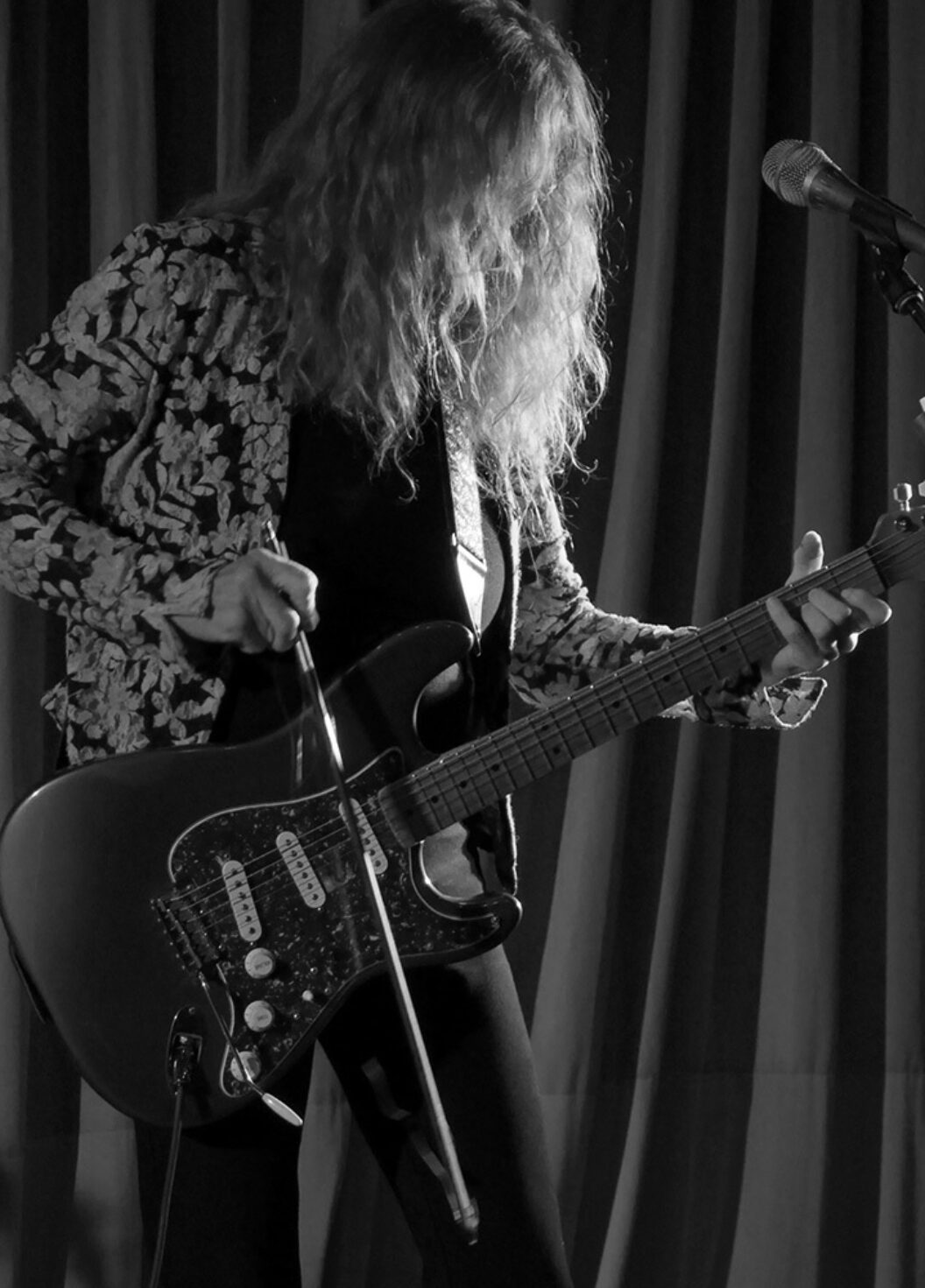
Photograph by Deidre Portney. Courtesy of SRO Artists, Inc.
Bird in a Cage (2020), the latest addition to Patty Larkin's 3-decade, thirteen-album career, is crafted from x poems past Nick Flynn, Marie Howe, Natalie Diaz, Kelle Groom, Stanley Kunitz, Robert Pinsky, May Sarton, Kay Ryan, William Carlos Williams, and Billy Collins. Larkin, a guitar-driven singer-songwriter, writes intensely visual lyrics that are rich in intricate wordplay. Five of her songs have been paired with movie and goggle box soundtracks, such every bit "Good Affair," which appeared in Columbia Pictures'southRandom Hearts. Fellow musician Mary Chapin Carpenter describes Larkin'due south atypical audio as "gorgeous, moving, provocative, of-the-world," adding that her guitar playing is "badass."
In 2018, I studied songwriting with Larkin at the Fine Arts Work Center and recognized a voracious reader, generous spirit, and gifted storyteller. Her guitar never left her side. With jeweled, dynamic, rhythmic instrumentals and memorable, airtight, innovative song phrasings, Larkin'southward lyrics wrestle with the complexity and quirks of everyday life with grace and humor. In her latest album, she pays homage to the fine art of the word past rendering each song as a character's voice that follows a poet's mind down unexpected paths she would take never traveled alone. Accomplished is a foot-tapping concert of dissolving boundaries that pierce the intimacies of earthen truths.
—Yvonne Conza
Poem past William Carlos Williams. Courtesy of SRO Artists, Inc.
Yvonne Conza What were you working through while crafting this album?
Patty Larkin I was looking for a new direction for my songwriting. This question sent me to the 2015 voice memos on my iPhone that I fabricated while searching for the reply to what I was "working through" when this projection began. I recall enjoying the freedom of not knowing precisely where I was headed. My intention and then was to record an instrumental tape. My archeological dig into my phone unearthed many musical snippets and ideas that I put down in pursuit of guitar pieces. It likewise revealed very rough versions of my song to Stanley Kunitz's "Passing Through," Baton Collins's "Introduction to Poetry," and two more of his poems, too as Marie Howe's "Magdalene on Romance."
YC How did this album develop?
PL During that time I was continuing to write new songs. I began my writing sessions by reading poems out loud. I had written a song to Kay Ryan's "Green Backside the Ears," which I recorded for my 2013 albumWithal Green, and it was a revelation for me to follow her words down into tune. I had likewise done a benefit in the summertime of 2014 with Marie Howe at the Fine Arts Piece of work Center, where I "backed her up" on an ambience electric guitar while she read; so I was becoming intrigued with the notion of combining music and verse.
And then I got together for coffee with writer and Twenty Summers Salon producer Joshua Prager who was putting the final touches on his volume100 Years: Wisdom From Famous Writers on Every Year of Your Life (2016). I told him he should get one hundred musicians to write music for each of the 1 hundred literary excerpts. He said, "Why don't you do it? I'll get yous a copy." And then at that place was my challenge! I paged through his book with my guitar on my lap. When I turned to the lines from Kunitz's "Passing Through," they vicious near immediately into song. My niece, who is writing a novel, describes that time as the creating stage, not the thinking phase. It's a dream state where one tin live in suspended atheism until the editorial process begins. That's where I was at the start of this project.
YC In the process of working with poems, what did yous discover?
PL Information technology reinforced how I am amazed by, and in search of, the fine art of the word and how to take an paradigm that has great depth so place it on the paper for the audio of it and too for the truth of the metaphor—the attain of the right word.
YC What stirred up inside of y'all every bit yous probed the language and narrative arcs of these poems?
PL Everything! The poems had to elicit an firsthand musical response from me in order for me to be able to continue working on them as songs. If I belabored the point, that's exactly how it would end up sounding. The inspiring aspect of it was when the poetry landed on a concept or a word choice that I would not have idea to employ. How to fit it into the melodic arc was the challenge.
I've always been inspired past great songwriters like Bob Dylan, Leonard Cohen, Joni Mitchell and how they are able to "read" the line then that it flows melodically; and in doing and so the line becomes arresting, believable, fresh. You want to listen to what they're saying. And and so, there is the voice. I accept always adhered to the Ernest Hemingway missive: tell the truth. So, if I could observe the voice of the poem, find the graphic symbol who is speaking the poem, I could sing it. Then at that place is the meaning. I was recently told by a radio DJ that he never "got" poesy in loftier school or college, but he understood these poems when I sang them. I had to delve deeper into the poems' beauty and meaning in order to find the vocalisation to sing them. I discovered possibilities for expression bachelor to me past way of a vocal inflection, note choice, variation, and tone.
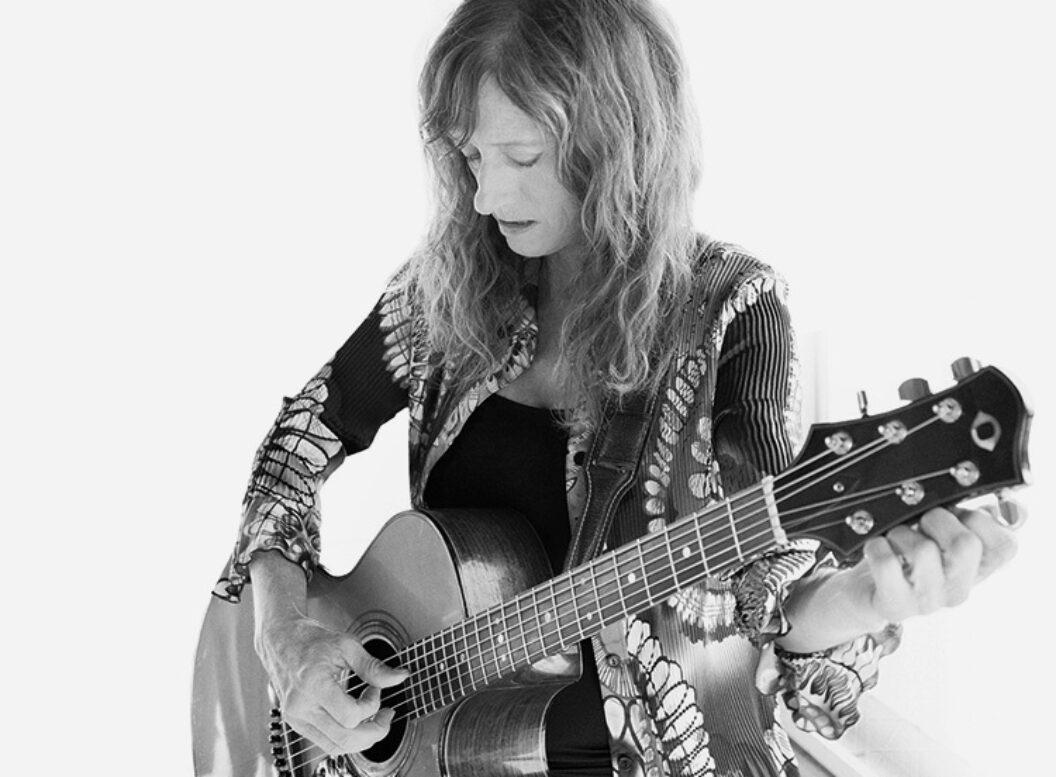
Photo by Jana Leon. Courtesy of SRO Artists, Inc.
YC "Passing Through" is a favorite of mine on your new album. What's the story behind information technology?
PL I came across Kunitz's poem "Passing Through," written on the occasion of his seventy-ninth birthday. I put my guitar into an open-C tuning, with the low string tuned down from E to C and the remaining strings in an open up-C chord: a rich, resonant audio. While thinking and not thinking, I wrote my 2d song inspired by a verse form, and it was the act of singing Kunitz's words that brought me closer to the emotional core of the poem. The ho-hum tempo of the music allowed for the words of the verse form to flow and fall in a cadence that I might not have immune myself if I had read it aloud. The line "gradually I'm changing to a give-and-take" became personal, evocative, and I was able to sing information technology in a way that held an element of surprise. I dubiety that I would take thought to cull that particular phrase in a song. To say one is gradually "changing to a word" is a rather remarkable thing to say. There is no "like" or "equally if" in the line. He is. Information technology was a cause for wonder. It makes total sense for Kunitz to transform into a give-and-take, as a distillation of his life and his work. In the way I chose to sing that line, I was able to add an element of discovery by mode of the texture in my voice and the timing of the phrase.
YC Is there a song in particular that was shaped or informed by the synergy of introspection and meditation that surprised, humbled, or led you to take greater risks with the music or song phrasing?
PL "Paradiso" tin bring me to tears. I sang it sitting with the guitar loop playing in my headphones, and this high, light vocal sprang along. Robert Pinsky'southward translation of Dante contains internal rhyme that created a very musical translation; the words vicious into a melody that was a song. It is otherworldly.
YC Did you institute any rules when crafting the poet'due south words into songs?
PL I challenged myself to sing the lines of the poems every bit written, to not change the lyric version to fit the melody, to exist truthful to the poets' lines. In my own songwriting do the words spring from melodies inspired past the guitar. To begin with the words or "lyrics" was new for me, and freeing.
YC What attribute of intimacy or connection with your audition were y'all reaching for while working on this album?
PL I wanted my listener to love each poem as much every bit I did, to be able to access its beauty. I wanted to open a door for my audience to walk into that low-cal while remaining truthful to the poet's work.
YC What does this album represent to you?
PL A dream; a thank yous to the poets; a claiming. To start with the concept and set the parameters is constricting but ultimately rewarding. It's likewise the terminal anthology I worked on with coproducer Mike Denneen, who passed away the summer of 2018. Mike was a producer and musician who had an encyclopedic knowledge of the history of pop music, among other things. More importantly, he had a true sense of how all the amassed bits of recorded musical sound might come up together to make a whole. He believed in my work and added to its depth with grace, humor, and kindness.
YC What do you feel your impact has been on the music world?
PLThe music globe is a color-full, shiny, screaming, hushed, minutely detailed splash of a jewel that is constantly whirling, spinning into new shapes. For me, to exist able to say that this is the jewel I accept been reaching for all of these years amazes me. That amazement is my impact on the music globe.
Yvonne Conza's writing has appeared in Longreads, Electric Literature, BOMB, AGNI, The Millions, Catapult, Cosmonauts Avenue, The Rumpus, Joyland Magazine, Blue Mesa Review, The Adroit Periodical and elsewhere in impress and online. She'southward a Pushcart Nominee and a finalist in many competitions including the Barry Lopez Creative Nonfiction award, The Raymond Carver Short Story award, and others.
Related
Elsbeth Pancrazi speaks with Cathy Park Hong, the author of the new volume of poetry,Engine Empire.
This veteran rocker still has a trick or two up his sleeve. He talks nigh hisAlive anthology, as well as a documentary by Timothy Greenfield-Sanders on his career.
Source: https://bombmagazine.org/articles/art-of-the-word-patty-larkin-interviewed/
0 Response to "Patty Larkin - the Book I'm Not Reading Live"
Post a Comment